
The Superior Court Clerk's Office
New Jersey does not use a Texas-style county district clerk. The correct court clerk for Superior Court case records is the statewide Clerk of the Superior Court, part of the New Jersey Judiciary. The current Clerk of the Superior Court is Michelle Smith. The office serves all 21 counties, including Passaic, from a central operation. The image below is the official Superior Court Clerk's Office page.
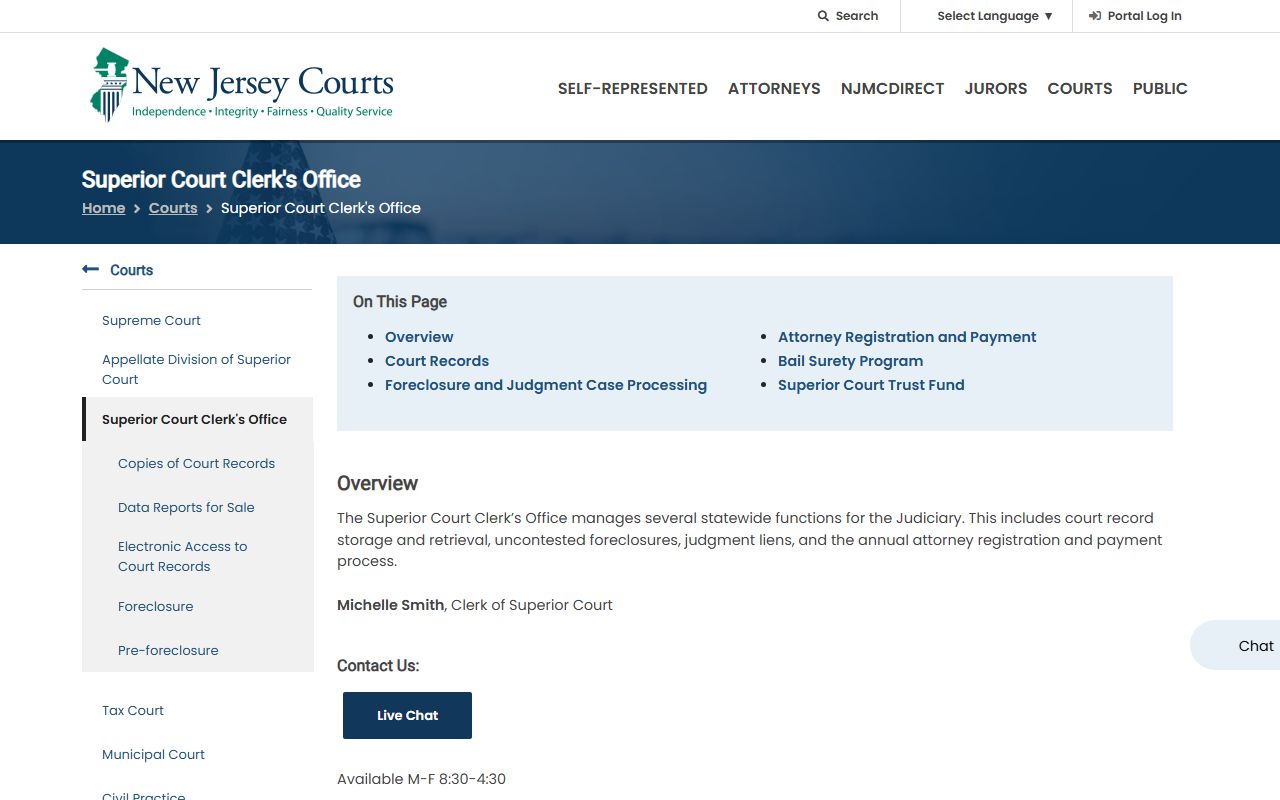
The page shown is the official Superior Court Clerk's Office. Because it is statewide, a Passaic County case is handled through the same central clerk processes as cases from other counties, with local divisions at the Passaic Vicinage for day-to-day matters.
What the Clerk of the Superior Court Handles
The office covers a broad set of court functions. These are not County Clerk tasks. The list below shows the core responsibilities tied to court records and case processing.
- Statewide court record storage and retrieval.
- Uncontested foreclosure processing.
- Judgment liens and judgment record management.
- Attorney registration and the annual payment process.
- Electronic access to case management systems.
- Bail surety program registration and enforcement.
- Superior Court Trust Fund processing.
Case-data reports also come from this office. For the search tools that draw on these records, see Passaic County court records.
The Superior Court Records Center
Active Passaic County cases are handled at the Passaic Vicinage. Once a case is resolved, the file does not stay at the courthouse forever. Closed Superior Court records transfer to the Superior Court Records Center after they are resolved.
The Judiciary directs the public to request those records from the Clerk's Office. So if an older Passaic case is not visible online, the file may sit at the records center, and a request through the Clerk is the way to reach it. Build in time, because pulling an archived file is slower than an online lookup.
This is why a name search can come up empty even for a case you know existed. Old, closed, or archived files may not be in the online database at all. A blank screen is not proof the case never happened. The records center, reached through the Clerk, is the next stop for those older matters.
Foreclosures and Judgment Liens
Two of the Clerk's functions touch a lot of Passaic County residents. Uncontested foreclosures are processed through the Clerk's Office, which moves a large share of the state's foreclosure volume. A foreclosure on a Passaic property runs through the Chancery Division and the central clerk process, using an F docket.
Judgment liens are the other big one. A money judgment can attach to property and follow a person for years. The Clerk maintains the statewide judgment records, and a judgment lien search runs by party name, judgment number, or docket number. If you are buying property or checking a debt, that search matters as much as the case docket itself. The court records page covers how to run it.
Clerk of the Superior Court Contact
The Clerk of the Superior Court operates from Trenton, with mailing and hand-delivery addresses for filings and requests. The contact card below has the details. Local Passaic matters can also be handled through the Passaic Vicinage division offices.
Superior Court Clerk's Office
P.O. Box 971
Trenton, NJ 08625-0971
Hand delivery: 25 Market Street, Trenton
609-421-6100
Passaic Vicinage Court Offices
77 Hamilton Street
Paterson, NJ 07505
973-653-2910
Mon-Fri 8:30 a.m.-4:30 p.m.
How to Request a Certified Copy
A certified copy carries an official seal and is what other courts and agencies usually accept. A printout of an online page is not certified. The steps below outline how to request a certified court copy through the Judiciary.
- Identify the case by docket number and party names.
- Decide whether you need a plain or certified copy.
- Use the Judiciary record request process or contact the Clerk's Office.
- For a closed file, expect it to come from the Superior Court Records Center.
- Pay the per-page copy fee and any certification fee.
For a divorce judgment, a name change, or a benefits claim, confirm the receiving agency wants a certified copy before you pay.
Court Records Request Fields
A court-record request asks for enough detail to find the file. The clearer the case identifiers, the faster the office can respond. The table lists what a request typically needs.
| Field Label | Type | Required | Notes |
|---|---|---|---|
| Requestor name and contact | Text | Yes | For the response |
| Docket number | Text | Strongly preferred | Exact case identifier |
| Party names | Text | Yes if no docket | Legal spelling |
| County | Text | Yes | Passaic |
| Copy type | Dropdown | Yes | Plain or certified |
| Payment | Payment | If fees apply | Per-page copy and certification |
Note: Court copy fees are charged per page; confirm the current per-page amount and certification fee with the Clerk before you mail a request.
The County Clerk Is a Different Office
This is the mix-up that sends people to the wrong window. The Passaic County Clerk is an elected constitutional officer, but it is not the clerk of the Superior Court. The County Clerk records deeds, mortgages, maps, trade names, military discharges, notary commissions, and election materials.
So when someone says they want a court records search at the County Clerk, they usually mean land records, which is a County Clerk function, while court case search runs through the Judiciary. For the County Clerk's own services, see the Passaic County Clerk page.
Electronic Access and Filing
The Clerk supports electronic access to case management systems. Attorneys file and access cases through eCourts, and the public uses NJ Courts public access tools for many record types. Returning users sign in with NJ Courts credentials, and first-time users register.
For attorneys, the office also runs the registration and annual payment process tied to a bar ID. For the public search side, the court records and court dockets pages explain how to use those tools, and the Superior Court page covers the court structure behind them.
Electronic access has limits. The Judiciary warns that displayed data is informational and offered without a guarantee of accuracy, and that some documents may not appear online at all. When the electronic file is not enough, the formal record request through the Clerk fills the gap.
One more practical tip applies to every request here. Spell names exactly as they appear in the case, and use the docket number whenever you have it. A clear, specific request reaches the right file faster and cuts down on back-and-forth with the office. Vague requests slow everyone down.