
Marriage Licenses Through the Local Registrar
New Jersey does not issue marriage licenses from one central county office for every resident. A marriage license comes from the local registrar in the municipality where either applicant lives. If neither applicant lives in New Jersey, the license comes from the town where the ceremony will take place.
The Passaic County Clerk handles notary work, passports, trade names, elections, and land records. It is not the main marriage-license office in the official county pages. So do not send every applicant to the County Clerk. Confirm the right municipal registrar first, since that is where the license and the local record live.
How to Apply for a Marriage License
The application happens at the local registrar, in person, before the ceremony. Both parties usually need to take part, and a waiting period may apply before the license is issued. Rules and hours vary by town, so confirm with the registrar first. The general steps look like this.
- Find the registrar in the municipality where one applicant lives.
- Confirm hours, the waiting period, and what to bring before you go.
- Bring required identification and any documents the registrar asks for.
- Complete the application together and pay the local fee.
- Receive the license after any waiting period and use it within its valid window.
Because neither the Passaic County Clerk nor the courts issue the license, the municipal registrar is the office that controls the timeline. Start there, not at the courthouse.
Certified Marriage Copies
A certified copy of a marriage record is the official version with a seal. The local registrar keeps local records, while the state vital records office maintains certified copies for many vital events. Only an eligible person, such as the subject, a spouse, or an authorized representative, can get a certified copy.
To request one, you usually provide the names, the date of marriage, the municipality, a statement of your relationship, a government ID, and the fee. The fields below show what a certified marriage copy request typically asks for.
| Field Label | Type | Required | Notes |
|---|---|---|---|
| Applicant / spouse names | Text | Yes | Legal names at the time of marriage |
| Date of marriage | Date | Yes or range | Exact date or a range |
| Municipality | Text | If known | Routes to the right registrar |
| Relationship / eligibility | Dropdown | Yes | Subject, spouse, or authorized person |
| Government ID | Attachment | Often | Identity for a certified record |
| Fee / payment | Payment | Yes | State or local fee applies |
Divorce in the Superior Court
Divorce is a Superior Court Family Part matter. Cases use FM docket numbers. The NJ Courts Find a Case page includes a divorce records option, and NJ Courts self-help has divorce filing guidance. The image below is the NJ Courts divorce self-help page.
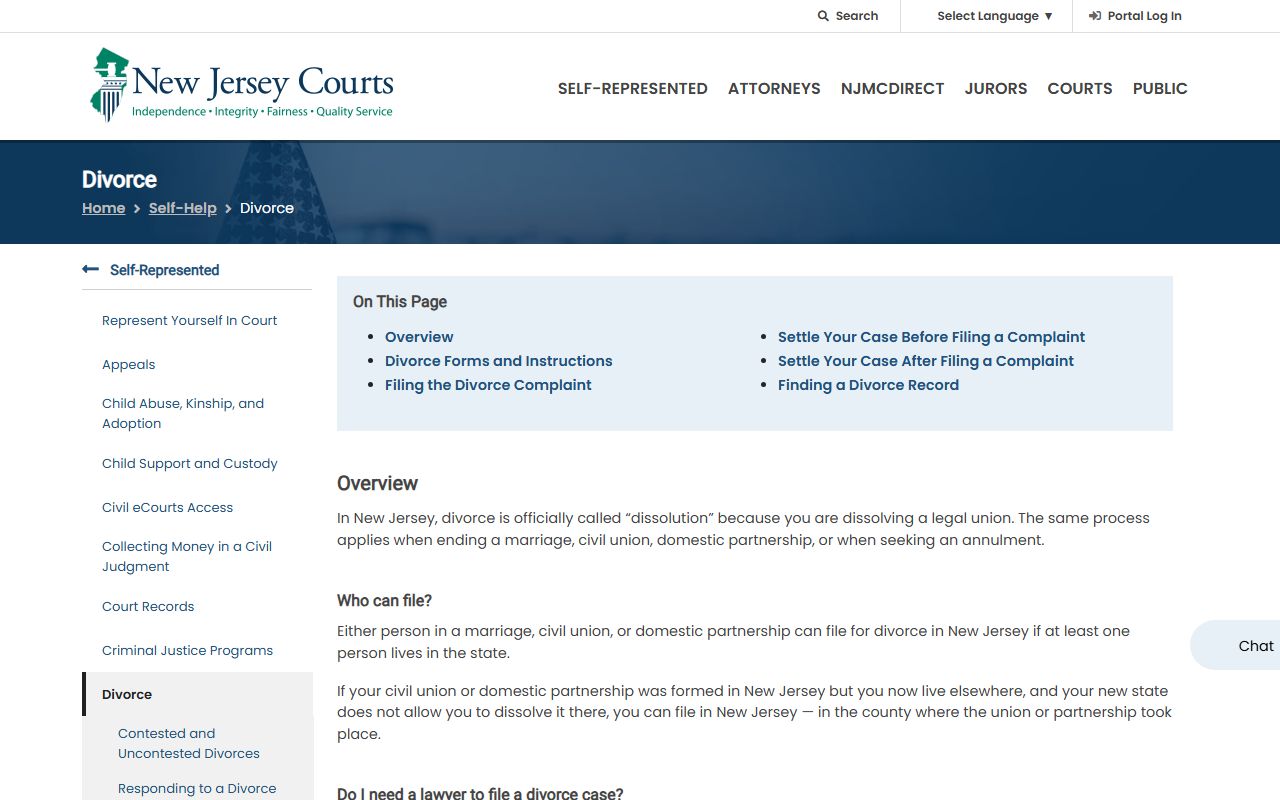
The page shown is the official NJ Courts divorce self-help resource. A divorce file may include the complaint, an answer or counterclaim, a case information statement, custody and support filings, a settlement agreement, the judgment of divorce, and post-judgment motions. Sensitive child, financial, and domestic violence details can be restricted or redacted.
Divorce Record Copy Requests
To find or copy a divorce record, the docket number and party names help most. You search through NJ Courts and request copies through the Judiciary record process. A certified copy of a judgment of divorce often matters for a name change, remarriage, or benefits. The fields below are typical of a divorce record request.
| Field Label | Type | Required | Notes |
|---|---|---|---|
| Docket number | Text | No | FM docket preferred |
| Party name | Text | No | Plaintiff or defendant names |
| County | Dropdown | No | Passaic |
| Year / date range | Date | No | Filing or judgment year |
| Copy type | Dropdown | For a request | Plain or certified if available |
Closed family files may take longer to pull. Build in time when a deadline is near, and confirm the copy type the receiving agency needs.
Know what you are asking for. A plain copy is fine to read a result, but a bank, a benefits office, or another court usually wants a certified copy with a seal. A name change after divorce, for example, often turns on the certified judgment. Ask the agency which version it accepts before you pay for the wrong one.
Filing for Divorce in Passaic County
People who file without a lawyer can use NJ Courts self-help. The path is the same whether a case is contested or uncontested, though the paperwork differs. The steps below outline the basic process.
- Confirm New Jersey residency and venue rules through NJ Courts self-help.
- Choose the right packet for your situation, such as contested or uncontested.
- File in the Superior Court Family Division for the proper county, likely Passaic.
- Pay the filing fee or request a fee waiver.
- Serve the other party under the court rules.
- Attend case management, mediation, or hearing events as ordered.
- Get a certified copy of the judgment through the court if you need one.
For the broader court file behind a divorce, see Passaic County court records and court dockets.
Confidential Family Records
Family records carry strong privacy protection. Under Rule 1:38, adoption, child abuse and neglect, and domestic violence victim information are restricted. Custody and support details in a divorce file can be redacted. Confidential personal identifiers, like Social Security numbers, are kept out of public filings.
This means a public divorce search may show a case caption and status while the substance stays sealed. A party to the case or an attorney can access more than the general public. For sealed records generally, the court records page explains the rules.
Legal Aid for Family Matters
Divorce and family cases can be hard to handle alone. Legal Services of New Jersey offers self-help information and aid intake for income-eligible residents. The New Jersey State Bar Association runs a lawyer referral service, and the Passaic County Bar Association serves the local area.
NJ Courts self-help also covers child support, custody, domestic violence, name changes, and fee waivers. For wills and estates after a death, which can intersect with family matters, see the Surrogate's Court page and the Clerk of the Superior Court for court record handling.
A fee waiver can open the door for people who cannot pay. NJ Courts lets eligible filers ask the court to waive certain fees, which matters for a divorce filing on a tight budget. Ask the Family Division or check the self-help pages about the fee waiver process before you assume cost will stop you. The Passaic County Bar Association can also help connect residents with a lawyer.