
OPRA vs Court Records in Passaic County
New Jersey runs two overlapping access frameworks. OPRA, at N.J.S.A. 47:1A-1, governs records held by executive and local agencies. Court records are governed mainly by New Jersey Court Rule 1:38 and Judiciary procedure, not OPRA alone. So the path depends on who holds the record.
A County Clerk land record, a Sheriff's civil process record, a county budget, and a health department file all fall under OPRA through the county. A Superior Court case file does not. Asking the County Clerk for a Superior Court filing will not work, because the Clerk is not the custodian of court case records.
The Correct Custodian Rule
OPRA Central is clear: a records request is not complete unless it goes to the custodian in charge of that record. Each agency keeps its own records and answers its own requests. That is why naming the right office first saves days of delay.
For court files, use the Judiciary record process or the division that holds the case. For a municipal court record, go to the municipal court where the matter is filed. For a criminal history check, the State Police process is different from a court docket search. Match the record to its keeper before you send anything.
How to File a Passaic County Public Records Request
An OPRA request works best when it is specific. OPRA Central explains how to ask for records and reminds requestors to reach the right custodian. The image below is that guidance page.
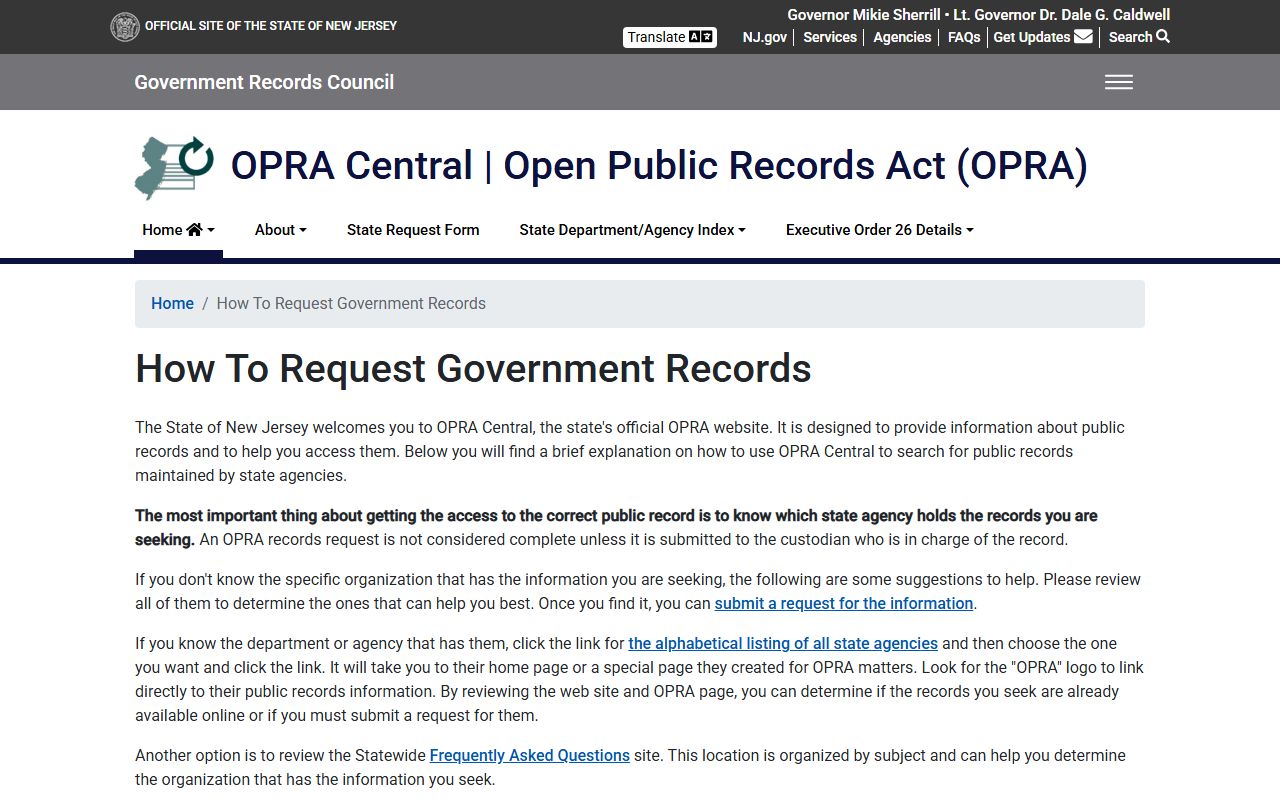
The page shown is the official OPRA request records guidance. Follow these steps to file a clean request.
- Identify the agency that holds the record you want.
- Describe the records specifically, with dates, names, and record type.
- Ask for existing identifiable records, not answers to questions.
- Send the request to that agency's OPRA custodian.
- Track the response and pay any copy fee that applies.
Do not ask a custodian to create a new record. OPRA covers records that already exist. For court filings, use court-record procedures instead of the county OPRA portal.
Public Records Request Fields
A request form, whether on paper or online, asks for a set of basics. The clearer you are, the faster the custodian can find the record. The table lists the fields a typical OPRA request includes.
| Field Label | Type | Required | Notes |
|---|---|---|---|
| Requestor name and contact | Text | Yes | For the custodian's response |
| Record description | Text | Yes | Dates, names, case or report numbers |
| Agency / department | Text | Yes | The custodian in charge of the record |
| Delivery method | Dropdown | No | Pickup, mail, or electronic |
| Payment | Payment | If fees apply | Copy or service fees |
What the Passaic County Clerk Maintains
The County Clerk is the official repository for documents affecting real property in Passaic County. The Registry Division records deeds, mortgages, cancellations, notices of settlement, lis pendens, tax sale certificates, powers of attorney, and assignments. The Clerk also handles passports, notary commissions, trade names, military discharges, and elections.
Land records are searched through the County Clerk PRESS system. Note that the Clerk does not perform title searches, and the Registry page gives a separate title-searcher phone line. A 2025 update flags that deeds with consideration over $1,000,000 may face a revised realty transfer fee. For the full Clerk profile, see the Passaic County Clerk page.
The Clerk also runs outreach beyond the main office. A satellite office in Wanaque serves the north end of the county, and the Clerk has offered mobile hours given how spread out Passaic County is. For property owners, the office maintains a property fraud warning system to flag suspicious recordings against a deed.
Driver and Vehicle Records
Some records people want are state agency records, not county ones. A driver history abstract comes from the New Jersey Motor Vehicle Commission, not from a court. It is different from a court traffic case record. The image below is the MVC driver history page.
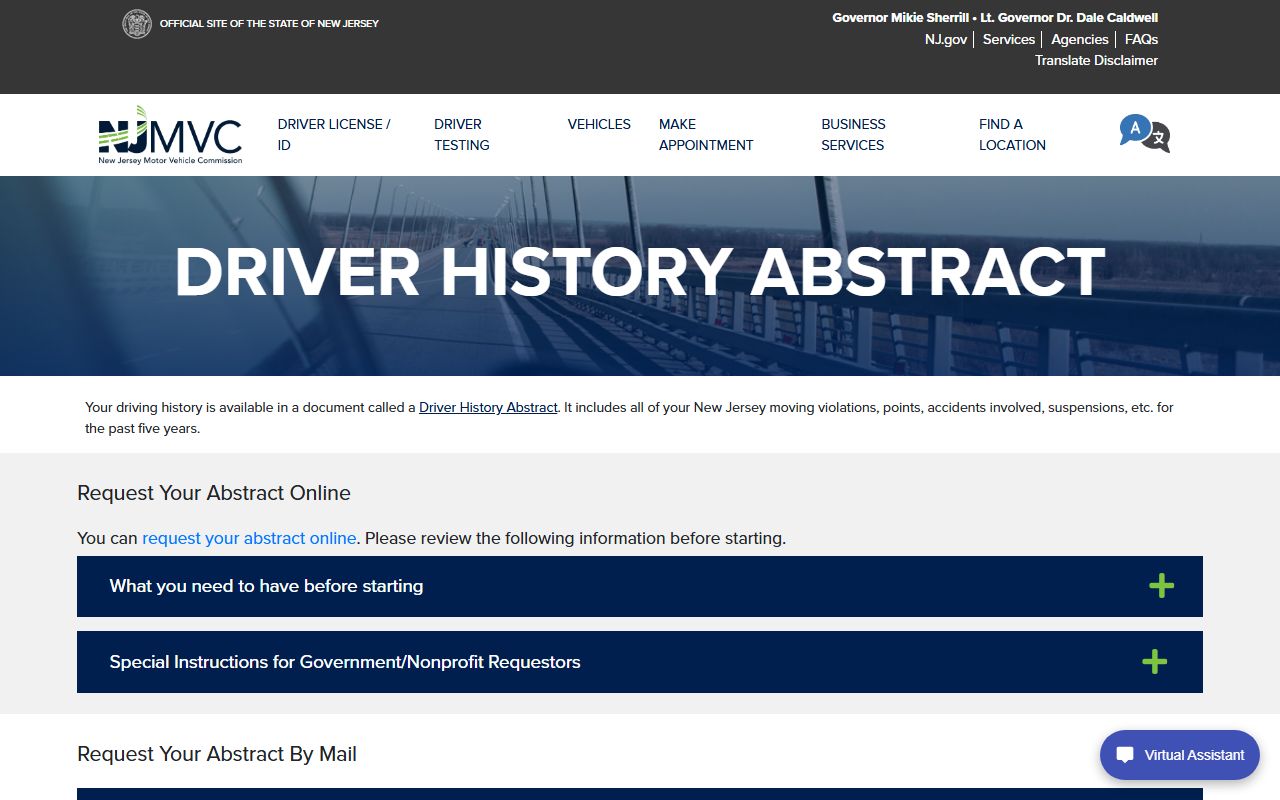
The page shown is the NJ MVC driver history abstract information. A driver abstract shows license status, convictions, points, and suspensions. A court traffic record shows a specific case. For the court side, see traffic court records.
Fees and Redactions
Different offices charge different fees. The County Clerk Registry has recording charges, and the Surrogate publishes copy fees. Court copies are charged per page. The table shows sample County Clerk Registry charges to give a sense of cost.
| Item | Charge |
|---|---|
| County Homelessness Trust Fund Act fee | $5 per document |
| Additional names over five | $6 per extra name |
| Missing official cover sheet | $20 per document |
Expect redactions on law enforcement records. Ongoing investigations, victims, juveniles, domestic violence, and medical information are commonly withheld or blacked out. Confidential personal identifiers are redacted under the court rules.
Judiciary Records Are Different
Court records sit outside the ordinary OPRA process. The Judiciary controls them under Rule 1:38 and its own directives. So an OPRA letter to the county will not produce a Superior Court case file. You use the court's public access tools or its record request process instead.
This split confuses many people. A criminal complaint, a divorce judgment, a civil docket, and a foreclosure file are all court records, not county agency records. They live with the Judiciary and the Clerk of the Superior Court. The OPRA framework, by contrast, reaches the county's administrative files, like budgets, contracts, and Sheriff records. Keep the two lanes separate and the search goes faster.
A missing online result is not proof a record does not exist. The case may be confidential, sealed, too old for the database, or not yet entered. When that happens, contact the right division or file a formal request rather than assuming nothing is there.
Denial Appeals
If a request is denied, you have options. Under N.J.S.A. 47:1A-6, a requestor can challenge a denial before the Government Records Council or in the Superior Court. The public agency carries the burden to prove the denial was allowed.
The path depends on the record. A county agency OPRA denial follows OPRA review. A court-record access denial follows Rule 1:38 review under the court rules. Pick the right route, and keep a copy of your request and the response. For the Judiciary side, see Passaic County court records and the Clerk of the Superior Court.
Records of your dated request matter most if you appeal. Note when you sent it, to which custodian, and what they said back. If the response was a denial, the reason given is what the Government Records Council or the court will weigh. A clean paper trail makes the review far smoother.